
EMDR Training That Prepares You for the Work Ahead
EMDR Basic Training for clinicians who want to feel genuinely prepared to use it well.
Why Train With EMDR Resource Center?
Comprehensive and theory-driven, built to stay with you after you leave the training room.
Most basic training leaves you with the protocol and sends you off to find the rest on your own. This one doesn't.
It is EMDRIA-approved, theory-driven, and paced across four modules, so what you learn has room to settle before you build on it. The required consultation hours are already woven into that schedule, so by the time you finish, you are not partway trained and hunting for a consultant. You are done.
This particular cohort is offered in Salem and on Zoom, taught by a trainer with more than 20 years of experience in the room with clients, and priced below most comparable programs.
Is This Training Right for You?
This training is designed for clinicians who want EMDR to feel practical, grounded, and connected to the clients they already serve.
Bring EMDR Into Your Current Practice
Your existing training does not get left behind. EMDR is an integrative approach that gives everything you already know a framework, making it more organized, more applicable, and more useful with the clients you are already sitting with. Clinicians consistently describe leaving this training understanding not just EMDR, but their clients more deeply.
Prepared for the Cases You Actually See
This training goes beyond the standard protocol. You leave understanding not just what EMDR is, but how and when to use it, and when not to. That is the practical application of EMDR therapy, beyond the protocol itself.
Consultation Built In
You get more than the 10 required consultation hours included in your tuition, with no separate consultant to find or pay for. You leave fully trained, not partway through the process.
Apply EMDR Across the Lifespan
Most basic training is built around adult presentations, leaving work with children, adolescents, and family systems as a footnote. This training covers the developmental adaptations, caregiver involvement, and clinical considerations that working across the lifespan actually requires.
What Makes Our Training Different
-
Consultation Is Included
To complete basic training you need 10 hours of consultation. Most programs do not include those hours in the tuition. You finish the training days and then find and pay for your own consultant separately. Here all 10 hours are woven into the training schedule and covered in the cost. You leave with everything done.
-
It Is a Better Deal
Most EMDR basic training programs do not include consultation in their tuition. You complete the training days and then arrange and pay for the required consultation hours separately before you can call yourself fully trained. Here, over 10 of the consultation hours required for basic training are woven into the training schedule and included in the cost. It is the more complete option, and when you account for what other programs ask you to add on, our training has a better value
-
Thorough and Grounded
This training is thorough, grounded, and applicable to the cases you are actually carrying, complex trauma, dissociation, children, adolescents, adoptive families, not just the straightforward presentations most trainings are designed around.
-
Taught From a Social Justice Lens
This training is taught by a woman of color from an anti-oppressive, trauma-informed lens. Not as an add-on. As the foundation of how EMDR is taught and applied here.
-
A Place Where It Is Okay to Be a Beginner
There is psychological safety in this learning environment. You can ask the questions you are not sure you are supposed to ask. Bring the cases you are struggling with. Be honest about where you are. That is what this training is designed to hold.
-
Four Modules Across Four Months, By Design
This is not a weekend intensive. Four modules, spaced three to four weeks apart, so what you learn in the training room has time to meet cases before you return. You will bring actual clinical questions back to consultation. That is by design. That spacing is how learning becomes something you can use.
Upcoming EMDR Basic Training Dates
-
Virtual Basic Training (Fall 2026)
Fall 2026
Thursdays + Fridays
8:30 AM – 5:30 PM PDTTraining Dates
September 17–18, 2026
October 15–16, 2026
November 19–20, 2026
December 10–11, 2026Lunch
12:30 PM – 1:45 PM
Long enough to accommodate a client if needed.Registration
The Fall 2026 virtual session closes on September 14.Format: Virtual — Live on Zoom
This virtual training follows the same EMDRIA-approved Basic Training curriculum, including live instruction, supervised practicum, and group consultation. This is not a pre-recorded course. -
In-Person Training (2026)
Location
Northwest Human Services I Salem, Oregon2026 Cohort
Thursdays + Fridays
8:30 AM – 5:15 PMTraining Dates
August 13–14, 2026
August 27–28, 2026
September 24–25, 2026
October 22–23, 2026Format In-Person — Salem, Oregon
This in-person cohort follows the same EMDRIA-approved Basic Training curriculum, including teaching, supervised practice, and consultation. -
Virtual Basic Training (Spring 2027)
Spring 2027
Thursdays + Fridays
8:30 AM–5:30 PM PDTTraining Dates
March 18–19, 2027
April 15–16, 2027
May 6–7, 2027
June 3–4, 2027Lunch
12:30 PM–1:45 PM
Long enough to accommodate a client if needed.Registration
The Spring 2027 virtual session closes on March 13, 2027.Format: Virtual, Live on Zoom
This virtual training follows the same EMDRIA-approved Basic Training curriculum, including live instruction, supervised practicum, and group consultation. This is not a pre-recorded course.
Meet Our Consultants
Alongside Wendy Sue, this training is supported by fellow EMDRIA-Approved Consultants who bring their own years of clinical practice to your consultation hours and practicum. Each trainer offers a distinct lens shaped by their own client work, giving you more than one perspective as you build your skills.

-
Dena Robertson Blackford, LMFT, is a Licensed Marriage and Family Therapist and an EMDRIA-Approved EMDR Trainer and Consultant. Trained in EMDR therapy in 2013, Dena specializes in helping adults heal from trauma, navigate life challenges, and create lasting emotional change. She maintains a private practice in El Dorado Hills, offering both in-person and teletherapy services.
Dena's primary therapeutic approaches include EMDR therapy and attachment-focused work. She integrates these evidence-based modalities to help clients process current symptoms, triggers, past traumatic experiences, and distressing life events that continue to impact their well-being today.
Clients seek her support for a wide range of experiences, including motor vehicle accidents, abuse, military trauma, sexual trauma, grief and loss, relationship challenges, attachment wounds, emotional neglect, criticism, breakups, humiliation, and other adverse life experiences.
Dena is committed to providing an inclusive, affirming environment and welcomes individuals from all cultural backgrounds, including members of the LGBTQ+ community.
Website: www.denarobertsonblackford.com

-
Jessi Maness is an LCSW who is passionate about EMDR therapy, and especially about offering consultation to other therapists. She completed her basic training in 2016 and became certified shortly after. Her journey to offering consultation has been much longer, and she has taken the learning of fidelity and understanding of the premises underlying EMDR therapy very seriously. She feels that every time she engages with other therapists, she is still learning new things, and this is very exciting to her.
Those interested in joining her for any part of this journey can request to be added to her mailing list for upcoming consultation opportunities or other offerings.
Email: jmaness3@icloud.com
Website: jessimanesslcsw.com

-
Jacqueline S. Armes, LMFT, is an EMDR Certified Therapist and EMDR Consultant-in-Training (CIT) who specializes in working with children, adolescents, adults, and families. She is trained in EMDR, DBT, DBT-PE, and EFT, and brings extensive experience helping clients navigate trauma, anxiety, depression, emotion dysregulation, and life transitions.
As an EMDR Consultant-in-Training, Jacqueline provides individual and group consultation to EMDR-trained clinicians who are working toward certification, strengthening their case conceptualization skills, or building confidence applying EMDR with children, teens, complex trauma presentations, and Spanish-speaking populations.
Learn more at initiativetherapy.com/emdr-consultation-for-therapists
Email: hello@initiativetherapy.com

-
Elizabeth "Liz" Langford, LPC, is an EMDRIA Consultant-in-Training who specializes in the integration of EMDR and play therapy with children, as well as developmentally-informed EMDR with adolescents. She also provides EMDR for adults, with a focus on emerging adults navigating a history of developmental, relational, or religious trauma. In addition, Liz offers EMDR intensives at her office in Portland, OR.
Liz employs two therapy animals — a bunny and a dog — to assist with all things therapy-related, including EMDR!
Consultation: Liz currently provides individual consultation, with a child-specific consult group launching in the fall. Consultation is available virtually or in person at her office in inner SE Portland.
Website: darngoodtherapypdx.com
Email: elizabeth.langford@counselingsecure.com

What clinicians say after training with Wendy Sue
"Wendy Sue Horn at EMDR Resource Center is an exceptional EMDR trainer. She offers an amazing culturally sensitive and trauma informed training. Taking her basic EMDR training transformed my practice and brought a deeper understanding of complex trauma so I can better serve my clients. If you or someone you know is thinking about EMDR, I highly recommend this training and her consultation services"
— Allison Poletti
“Not only did this training offer me a solid grounding in EMDR, I also learned valuable perspectives about working with PTSD and complex trauma in general. Wendy Sue was a knowledgeable and skilled trainer, and I would highly recommend this training to anyone wanting to learn EMDR--especially if you work with children!”
— Lydia Evans
“This was an amazing training. Possibly one of the best ones I have participated in. Wendy Sue's knowledge and depth on trauma and EMDR treatment of trauma was phenomenal and I am so glad I was able to participate. I am grateful to have been able to learn so much for my future work with clients”.
— Robbin Vanrys
Scholarship Support for Eligible Oregon Clinicians
If you are a licensed Oregon clinician serving children and families in foster care, resource care, or post-permanency and billing Oregon Health Plan's Care Oregon insurance, you may qualify for full scholarship funding through our partnership with Oregon's Department of Human Services.
Scholarships cover both Basic Training and ongoing consultation hours toward EMDRIA certification. TAC alumni receive priority consideration. Spaces are limited and fill quickly. Please share this with any colleagues who may be eligible.
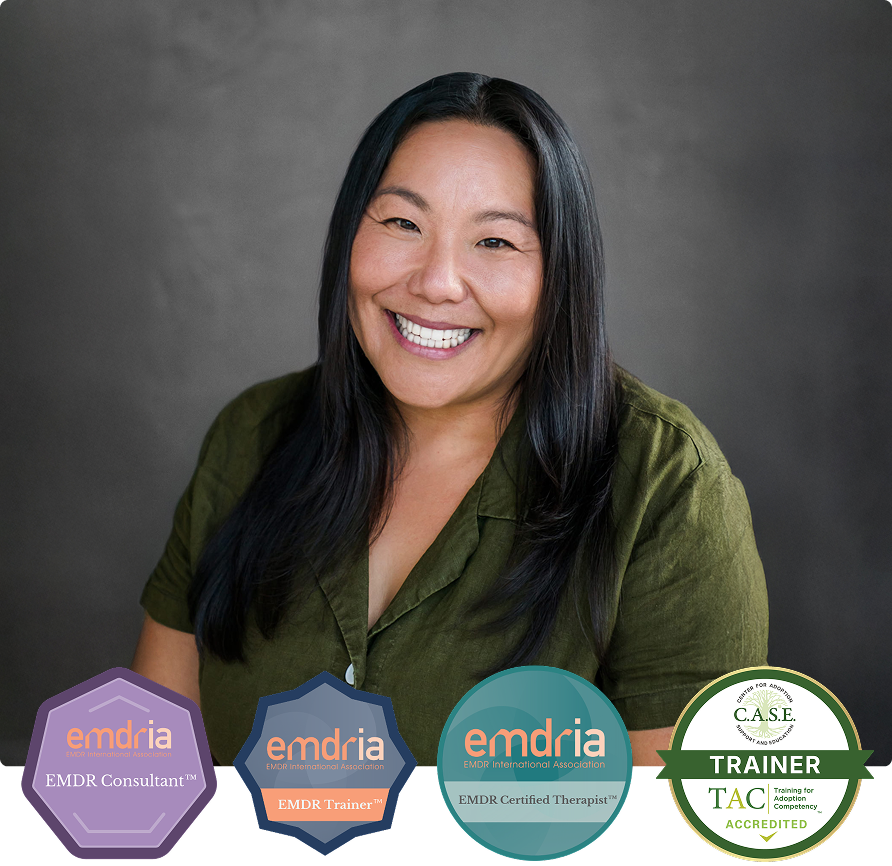
Meet The Clinician Behind EMDR Resource Center
Wendy Sue Horn is an EMDRIA-approved trainer, consultant, and clinician with over twenty years treating children, adolescents, adults, and parents in private and public settings. She teaches from a social justice and anti-oppressive lens because that is how she practices, not as an add-on.
Clinicians who train with Wendy Sue leave more organized, more prepared, and clearer about their own clinical thinking.
Course Details, Learning Objectives & Requirements
This EMDRIA-approved Basic Training gives clinicians the knowledge and skills to begin using EMDR therapy in clinical practice. The curriculum includes didactic instruction, hands-on practicum, and group consultation delivered across four two-day modules.
Participants learn to apply EMDR therapy across the lifespan, including work with straightforward PTSD, complex trauma, anxiety, depression, dissociation, and other clinical presentations.
This training meets continuing education requirements for licensed clinicians. 46 CEs are available through CE-Classes.com — see Continuing Education Credits for full approval details by state and licensing board.

-
This intensive and comprehensive program equips participants with the knowledge and skills to begin using EMDR therapy in their clinical practice. The curriculum combines didactic instruction (25 hours), hands-on practicum (21 hours), and group consultation (12 hours) delivered over a convenient four-part format. The program is offered by the EMDR Resource Center, which is accredited by the EMDR International Association (EMDRIA).
Participants gain a strong foundation and applying evidence-based EMDR therapy to treat a wide range of clinical presentations across the lifespan. This includes formulating case conceptualizations using attachment theory, structural dissociation theory, and the Adaptive Information Processing (AIP) model developed by Dr. Francine Shapiro, the founder of EMDR. Through supervised practice, participants learn to implement all eight phases of EMDR therapy effectively. The program focuses on treating various conditions, including simple and complex PTSD, anxiety disorders, depression, and other diagnoses outlined in the DSM-5.
Upon successful completion, participants are fully EMDR Trained and leave with the skills and qualifications necessary to pursue EMDRIA membership and access its associated benefits.
-
You must attend all training days and actively participate in all supervised practice exercises and group consultation sessions in order to earn CE credits and receive documentation of completion for this training.
Those who attend this workshop in full and complete all the appropriate evaluation forms will receive CE credits.
Those arriving more than 15 minutes after the start time or leaving more than 15 minutes before the training is completed will not receive CE credits.
-
Licensed
To be accepted for the EMDR Resource Center basic training in EMDR therapy program you must be licensed for independent practice as a mental health clinician or meet alternate EMDR International Association eligibility criteria.Prelicensed
Graduate students, post-graduate pre-licensed clinicians, and non licensed clinicians must submit additional documentation with their application. See the “Non Licensed Applicant Instructions” on the Registration Forms page.Alternate Eligibility
Clinicians who have completed or who are enrolled in a program in Art Therapy or Drug and Alcohol Counseling must contact EMDRIA about their program in order to determine their eligibility. If EMDRIA approves your education and licensure status, please submit approval documentation from EMDRIA with your application. -
Describe the key principles of the Adaptive Information Processing (AIP) model.
Describe the five elements of Francine Shapiro’s (2018) model of a memory network.
Describe the effects of trauma on information processing.
Describe how to provide effective stabilization procedures and EMDR therapy to persons referred for PTSD, panic disorder, and phobias of a traumatic origin.
Explain EMDR therapy’s standard 3-prong protocol.
Describe at least three different theoretical mechanisms underlying EMDR therapy’s treatment effects.
Evaluate which measure of dissociation is appropriate for use based on client presentation.
Determine whether a client meets the readiness criteria for EMDR therapy reprocessing or requires extended preparation for reprocessing.
Describe the importance of assessment for dissociation before the onset of EMDR therapy reprocessing.
Apply standardized assessment measures, tools, and/or structured interviews to screen all prospective EMDR therapy clients for dissociation prior to applying any bilateral stimulation.
Demonstrate at least three different client stabilization procedures and the rationale for their use.
Discuss possible cultural adaptations within the eight phases of EMDR therapy’s standard protocol.
Create a treatment plan that includes a targeting sequence for EMDR therapy reprocessing based on a history of symptoms, the history of the client and their treatment goals.
Summarize the purpose of each of the eight phases of EMDR therapy standard protocol, as well as the sequential steps in each of the eight phases.
Describe client’s verbal and nonverbal responses that indicate effective EMDR therapy reprocessing.
Name the four causes of EMDR therapy ineffective reprocessing.
Demonstrate procedures for closing an EMDR therapy reprocessing session.
Evaluate the client’s need for stabilization at the close of each EMDR therapy session.
Explain the differences and similarities between EMDR standard protocol and EMD.
Describe possible technical and procedural adaptations to EMDR therapy’s standard protocol needed for use with children and adolescents.
Describe possible reasons why EMDR therapy treatment of active-duty military personnel and veterans is a specialty area.
Create at least four specific phobia questions to develop a targeting sequence for EMDR therapy reprocessing.
Describe at least two specialized protocols for EMDR therapy use with substance use disorders.
Describe the purpose and procedure for utilizing Arne Hoffman’s (2010) Inverted Protocol for clients with complex PTSD.
-
46 CEs will be available for this training. CE-Classes.com is the provider of (CEs).
Certificates are awarded online after completion of the workshop. Participants print their own certificate after registering at CE-Classes.com, entering a keycode, and completing an evaluation form.
Licensed Professionals should contact their regulatory board to determine course approval.
CE-Classes.com is approved by:
The American Psychological Association (APA) CE-Classes.com is approved by the American Psychological Association to sponsor continuing education for psychologists. CE-Classes.com maintains responsibility for this program and its content.
Florida Certification Board
The Florida Board of Clinical Social Work, Marriage and Family Therapy and Mental Health Counseling Provider #852 BAP-Expires 3/31/2025
The California Board of Behavioral Sciences. The California Board of Behavioral Sciences, BBS, recognizes relevant course work/training that has been approved by nationally recognized certifying bodies, such as APA, to satisfy renewal requirements.
California Consortium of Addiction Programs and Professionals (CCAPP) Provider Number OS-12-174-0225 Expires 02-2025
The Texas Board of Social Work Examiners – CE-Classes.com meets the requirements for acceptable continuing education. Effective 1/1/24, at least half of the 30 hours must be obtained from a provider listed in 801.261(f). This course meets that requirement.
The Texas Board of Professional Counselors – CE-Classes.com meets the requirements for acceptable continuing education. Effective 1/1/24, at least half of the 30 hours must be obtained from a provider listed in 801.261(f). This course meets that requirement.
The Texas Board of Marriage & Family Therapists – CE-Classes.com meets the requirements for acceptable continuing education. Effective 1/1/24, at least half of the 30 hours must be obtained from a provider listed in 801.261(f). This course meets that requirement.
Massachusetts Authorization Number: (TBD)
Ohio Counselor, Social Worker and Marriage and Family Therapist Board – Approval from a state licensing board for counselors, social workers, marriage and family therapists is accepted by the OH CSWMFTB.
New York Social Work Board – CE-Classes.com is recognized by the New York State Education Department’s State Board for Social Work as an approved provider of continuing education for licensed social workers #SW-0120.
New York Mental Health Practitioners Board CE-Classes.com, Inc. is recognized by the New York State Education Department’s State Board for Mental Health Practitioners as an approved provider of continuing education for licensed mental health counselors. #MHC-0260.
New York Psychology Board CE-Classes.com, Inc. is recognized by the New York State Education Department’s State Board for Psychology as an approved provider of continuing education for licensed psychologists #PSY-0211
Oklahoma Board of Behavioral Health Licensure (LPCs, LMFTs and LBCs)
South Carolina – CE-Classes.com is approved by the S.C. Board of Examiners for Licensure of Professional Counselors, Marriage & Family Therapist, Addiction Counselors, and Psycho-Educational Specialists (#4696).Illinois – CE-Classes.com is a registered social work CE sponsor by the State of Illinois. License 159.001607 Expires 11/30/2025
The Florida Board of Nursing (CE Provider #: 50-4896) Expires 10/31/2026 Do not send certificates to the Florida Board of Nursing. You must keep this certificate for 4 years.
The California Board of Registered Nursing. CEP 15647 Expires 11/30/2024.
This course is NOT available for NBCC credit
This training does not offer ASWB ACE credit to social workers.
-
As an EMDRIA-approved consultant and trainer, Wendy Sue has been mentoring therapists in trauma treatment and dissociation for 10 years. Her teaching journey began in 2005 at San Jose State University, she has continued to pursue her love for teaching and training, actively participating as an EMDR consultant in basic training since 2014. Additionally, since 2021, Wendy Sue has been teaching a certification program in trauma and adoption-competent mental health services offered to clinicians by the Oregon Department of Human Services in collaboration with the Center for Adoption Support and Education (C.A.S.E.).
A seasoned clinician helping individuals, adolescents, and parents for over 20 years, expert in the field of EMDR therapy; anxiety disorders, PTSD, complex trauma, dissociation and perinatal mood disorders. She maintains her private practice in Portland, Oregon while also licensed in California where she treats clients virtually.
-
Our trainings broken into 4, two day parts. (8:30 am to 5:30 pm) spaced apart by at least three to four weeks to maximize participants’ ability to apply their learning with their current clients. Building supervised practice into each part allows participants to apply the material learned from the didactic portion of the training immediately. Beginning in Weekend Two, mornings are spent in consultation where participants present the cases they are applying their newly acquired EMDR skills to between training days. The consultation is wrapped into the training days to solidify the application of concepts from each section of the training. Foundational concepts and preparation steps are applied to the participant’s clients after the first training section. Standard EMDR Therapy protocol is applied to the participant’s clients after the second and third sections. Our EMDR training program empowers you to integrate EMDR into your practice with confidence. You’ll gain the skills and knowledge to develop effective EMDR case formulations and treatment plans for your existing caseload. By the conclusion of your EMDR Basic Training, you will be EMDR Trained using EMDR Standard Protocol!
-
Four two-day training modules are spread over four months. Modules are spaced three to four weeks apart so participants have time to practice new skills, study course readings, and return with stronger clinical questions.
Each module includes focused periods of lecture, practice, and consultation. Morning and afternoon breaks are 15 minutes. Lunch breaks are 75 minutes.
Module 1: Days 1–2
Day 1
Lecture: 4.25 hours
Practice: 3 hoursDay 2
Lecture: 4.25 hours
Practice: 3 hoursModule 2: Days 3–4
Day 3
Consultation: 1.5 hours
Lecture: 3 hours
Practice: 2.75 hoursDay 4
Consultation: 1.5 hours
Lecture: 3 hours
Practice: 2.75 hoursModule 3: Days 5–6
Day 5
Consultation: 1.5 hours
Lecture: 3 hours
Practice: 2.75 hoursDay 6
Consultation: 1.5 hours
Lecture: 3 hours
Practice: 2.75 hoursModule 4: Days 7–8
Day 7
Consultation: 1.5 hours
Lecture: 3 hours
Practice: 2.75 hoursDay 8
Consultation: 1.5 hours
Lecture: 2 hours
Practice: 2.25 hours
Consultation: 1.5 hoursTraining Totals
8 training days
10.5 hours of consultation
25.5 hours of lecture
22 hours of practice -
Module 1: Days 1–2
Both days follow the same schedule.
Lecture: 8:30 AM – 9:45 AM
Morning Break: 9:45 AM – 10:00 AM
Lecture: 10:00 AM – 11:00 AM
Practice: 11:00 AM – 12:30 PM
Lunch: 12:30 PM – 1:45 PM
Lecture: 1:45 PM – 3:45 PM
Afternoon Break: 3:45 PM – 4:00 PM
Practice: 4:00 PM – 5:30 PMModule 2: Days 3–4
Both days follow the same schedule.
Consultation: 8:30 AM – 10:00 AM
Morning Break: 10:00 AM – 10:15 AM
Lecture: 10:15 AM – 12:30 PM
Lunch: 12:30 PM – 1:45 PM
Lecture: 1:45 PM – 2:30 PM
Practice: 2:30 PM – 3:45 PM
Afternoon Break: 3:45 PM – 4:00 PM
Practice: 4:00 PM – 5:30 PMModule 3: Days 5–6
Both days follow the same schedule.
Consultation: 8:30 AM – 10:00 AM
Morning Break: 10:00 AM – 10:15 AM
Lecture: 10:15 AM – 12:30 PM
Lunch: 12:30 PM – 1:45 PM
Lecture: 1:45 PM – 2:30 PM
Practice: 2:30 PM – 3:45 PM
Afternoon Break: 3:45 PM – 4:00 PM
Practice: 4:00 PM – 5:30 PMModule 4: Day 7
Consultation: 8:30 AM – 10:00 AM
Morning Break: 10:00 AM – 10:15 AM
Lecture: 10:15 AM – 12:30 PM
Lunch: 12:30 PM – 1:45 PM
Lecture: 1:45 PM – 2:30 PM
Practice: 2:30 PM – 3:45 PM
Afternoon Break: 3:45 PM – 4:00 PM
Practice: 4:00 PM – 5:30 PMModule 4: Day 8
Consultation: 8:30 AM – 10:00 AM
Morning Break: 10:00 AM – 10:15 AM
Lecture: 10:15 AM – 12:15 PM
Lunch: 12:15 PM – 1:30 PM
Practice: 1:30 PM – 3:45 PM
Afternoon Break: 3:45 PM – 4:00 PM
Consultation: 4:00 PM – 5:30 PMProgram ends after Day 8.
Listed times are Pacific Time Zone
Check your time zone against San Francisco World Clock Meeting Planner -
The total tuition for EMDR Basic Training is $1,350.
You may pay in full at registration or split tuition into two payments:
Installment 1: $675 due at registration
Installment 2: $675 due one week before training beginsThe first payment is non-refundable.
-
Cancellation Policy – The following conditions apply if withdrawal from the training is necessary after acceptance: 1) Full refund minus a $150. administration fee 30 days or more before the training onset, 2) Within 30 days prior to training onset no refunds will be issued for any reason, and 3) After the onset of training, no refunds will be issued for personal reasons or business situations, including medical circumstances as vacancies after the onset of training cannot be filled. Any refund requests must be in writing via email to the Director of Training: wendysue@emdrresourcecenter.com The following additional conditions apply if you need to withdraw from the training after acceptance: 1) You may request in writing via email to the Director of Training (wendysue@emdrresourcecenter.com) transfer to a future training cycle with an associated transfer fee of $150, 2) When the time between the first and second training course is six months or less, and if you attended and satisfactorily completed only weekend one of the course, then you may resume training at weekend two of the next training course, 3) If you only attended and satisfactorily completed weekends one and two of the course, then you are required to start again at weekend two of the next training course, 4) If you attended and satisfactorily completed weekends one, two and three in one course, then you may return and take just weekend four of the next training course, 5) Before satisfactorily completing the course, you may elect to start over and attend all four weekends of one course. For purposes of this registration, if you attend only one day of a weekend, that will be considered as if you had not attended that weekend at all, 6) If the time between the first and second training courses is more than six months, you will be required to start over and attend all four weekends at the next training course, and 7) Only one transfer to a future EMDR basic training course (which has an associated $150. transfer fee) is allowed.
Satisfactory Completion – Participants must have paid the tuition fee, signed in and out each day, attended the entire program, and completed all course requirements in order to receive a certificate. Failure to sign in or out will result in forfeiture of credit for the entire course. No exceptions will be made. Unfortunately, partial credit is not available. Certificates will be available following course completion via the Canvas learning management system platform. You may view the course requirements within the Participation Agreement prior to finishing the registration process for this course (near the top of this landing page, click the ‘register now’ button to view the contents of the Participation Agreement).
Conflicts of Interest – There is no known conflict of interest or commercial support for this program.
Accessibility Policy – This program adheres to the standards of the Americans Disabilities Act. Please contact us if special accommodation is required.
Grievance Policy – We seek to ensure equitable treatment of every person and to make every attempt to resolve grievances in a fair and timely manner. Please email us with your written grievance. Grievances will receive, to the best of our ability, timely corrective action in order to prevent further problems.
-
EMDR Resource Center welcomes trainees and consultees from all cultural, religious, and socioeconomic backgrounds, sexual and gender orientations. We pledge to proactively address issues of cultural competence and culturally-based trauma during every phase of professional development.